Under the Hood · Part 1 · 6 min read
Stop polishing the engine
Why the smartest AI isn't the one that wins.
By Aikansh ·
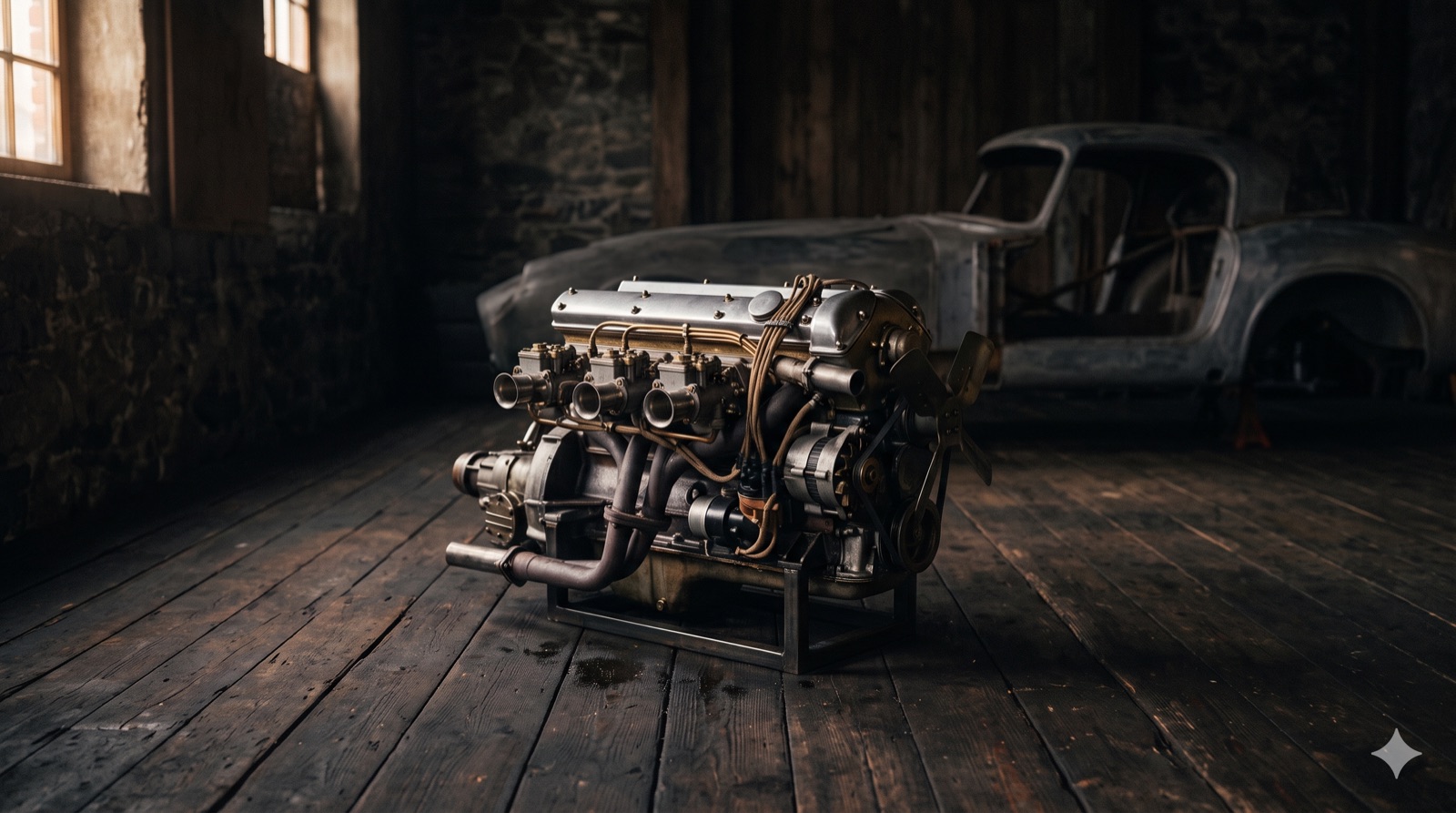
Bolt a Formula 1 engine to a wheelbarrow and race it against a Honda Civic. The Civic wins. Not because its engine is better — it isn't even in the same universe — but because it's a car, and the wheelbarrow is not.
For two years, the entire AI industry has been building a better engine. Bigger context windows. Higher benchmark scores. Faster inference. Every launch, another few horsepower. We were all staring at the engine. And somewhere in the last year, while we were staring, the race quietly moved to the car.
The thing that took me too long to see
The model was almost never the bottleneck. The harness around it was.
By "harness" I mean everything that turns a brilliant text-predictor into something that can actually get work done. On its own, a model is an engine on a stand in a showroom — magnificent, loud, and going precisely nowhere. What makes it useful is the car you build around it. And it turns out the engine is the least of it — around it sit five more parts, and each of the next five pieces in this series opens up one.
THE REST OF THE CAR — FIVE PARTS
- Memory — the small desk it works on. It carries context so work survives past a single sentence. A model with no memory wipes the desk clean after every reply — every question starts from nothing. (Part 2.)
- A persona — who you tell the driver to be. Tell it to answer as a careful lawyer, or a blunt editor, and the same question gets a different answer. (Part 3.)
- Wheels — how it touches the road. The tools that let it actually do things: run the code, open the software, send the email. A genius who can only talk is a passenger. (Part 4.)
- Gauges — how it knows if it worked. Feedback: the way it can tell it's on the road or in a ditch. Where there's no gauge, it drives confident and blind. (Part 5.)
- The driver — the loop that ties it together. Give it a destination and it drives: act, look at what happened, correct, go again — until it arrives. (Part 6.)
Memory, a persona, wheels, gauges, a driver — wrapped around the engine. That's a car. Miss any one of them and you've got a very expensive object that does not take you anywhere. The next five pieces take them one at a time; by the end, you'll see the whole thing drive.
Once you see it, you can't unsee it
Here's the part that turned the lights on for me. Every time you've been let down by AI — it forgot what you told it, it stopped halfway, it gave you brilliant words but couldn't actually do the thing — you were blaming the engine. You were saying "it's not smart enough yet."
It was almost always the car.
The labs already know this. The whole frontier has quietly shifted from "whose engine is biggest" to "whose car drives best" — from a smarter chatbot to a system that can remember, act, and keep going on its own. The smartest model loses to a well-built one, every time, the same way the F1 engine loses to the Civic.
Stop polishing the engine.
Build the car.
TRY IT — 2 MINUTES
Give the same real task to two things — a plain chatbot (the engine alone) and an agent like Claude Code (the whole car):
"turn this messy list of names and emails into a clean CSV file"
The chatbot shows you the text and stops. The agent writes the actual file and hands it back. Same engine underneath — the difference you just watched is the car.
Next: the part of the car that decides how much of what you told it survives to the next sentence — its memory.
FOR THE CURIOUS — WHAT'S ACTUALLY HAPPENING
A model, by itself, is a function: text in, text out, no memory, no side effects. Everything that makes it feel like an agent lives outside it — context management, tool use (increasingly standardized through protocols like MCP), the loop that runs it, and the autonomy that lets it keep going. The model proposes; the harness disposes.
You can watch the shift in the market. The clearest signal isn't a new model — it's the plumbing. Anthropic's Model Context Protocol went from a niche idea to roughly 97 million monthly SDK downloads by early 2026, and was donated to a new Linux Foundation body for agent standards, the Agentic AI Foundation.1 Even the folk heroes are harness stories: OpenClaw, an open-source personal agent that just keeps working in your messaging apps, went from a side project to more than 200,000 GitHub stars within its first few months — and its creator was hired by OpenAI along the way.2 Nobody starred it for a smarter model. They starred it for the car.
One honest caveat, so the analogy doesn't oversell: a better engine still helps. A stronger model inside a good harness genuinely drives better. The claim isn't that the model stopped mattering — it's that it stopped being the bottleneck, and the leverage moved to the car.
SO WHAT DO YOU DO?
Before you reach for a smarter model, check whether your setup is even a car yet. Same engine, three different vehicles:
- A chatbot with no memory — an engine on a stand. Brilliant answers; nothing carries from one to the next.
- A coding agent with a terminal and tests — a car. It writes, runs, sees what broke, and fixes it. The loop and the tools are the wheels.
- A finance assistant with no account sync — an engine pretending to drive. It can reason about money it can't actually see. Give it memory and tools before you give it a bigger brain.
SOURCES & NOTES
- MCP reached roughly 97 million monthly SDK downloads (official TypeScript + Python SDKs) by early 2026, and was donated to the Linux Foundation's Agentic AI Foundation in December 2025. Anthropic, “Donating the Model Context Protocol…”; Linux Foundation, AAIF formation announcement.
- OpenClaw crossed 200,000+ GitHub stars within its first few months of release (early 2026); its creator, Peter Steinberger, joined OpenAI in February 2026. Engadget, “OpenAI has hired the developer behind AI agent OpenClaw.”